Transart draft Proposals
Research and studio 2009-2010
Work Year-1
davidalesworth.com (blog links also on home page)
Research-Proposal (year-2)
Draft title: “Working the Garden, a consideration of the garden in contemporary Pakistan”.
Towards my studio work
"A Taxonomy of Eden" I will be researching gardens and urban landscape in contemporary Pakistan. This will include varying attitudes to the notion of nature, wilderness and the paradise garden. Also the legacy of aging colonial parks. Besides readings (see bibliography below) I will interview a cross section of contemporary society from career gardeners in Lahore's parks, agricultural workers, religious scholars (and lay practitioners from various religions and sects) the educated and the less educated in the city and countryside of Lahore and Karachi (possibly further afield also). From nursery owners, the head of the Punjab Horticultural Authority to jobbing residential gardeners in the Defence housing authorities of Karachi and Lahore. This will follow a format of recordings, translations, transcriptions and analysis. Also photography and some video. I work as a freelance horticultural consultant in Pakistan and have done so for the past 21 years. My clients currently include Agha Khan Cultural Services Pakistan, with whom I am working on several restoration projects, including the uplift of the North Circular Park belt around Lahore's old city.
(Sacred Texts. Garden Design. Garden History. Landscape. Popular Culture. Decorated Transport. Trees on the edge between nature and culture. Motifs. Carpets. Ageing colonial public parks in Lahore. The culture of the Mali.)
“Working the Garden”
Draft Bibliography (11 July 2009) Part Questia, part owned.
Albinia, Alice. Empires of the Indus. John Murray. 2008.
Anderson, Earl R. Folk-Taxonomies in Early English. Madison, NJ: Fairleigh Dickinson University Press, 2003.
Anderson, Edgar. Plants, Man and Life. Boston: Little, Brown & Company, 1952.
Anesaki, Masaharu. Art, Life, and Nature in Japan. Boston: Marshall Jones Company, 1933.
Arber, Agnes. Herbals, Their Origin and Evolution: A Chapter in the History of Botany, 1470-1670. Cambridge, England: University Press, 1938.
Aubrey, James R., ed. John Fowles and Nature: Fourteen Perspectives on Landscape. Madison, NJ: Fairleigh Dickinson University Press, 1999.
Aydon, Cyril. Charles Darwin, His life and times. Running Press. 2008.
Bailey, L. H. How Plants Get Their Names. New York: Dover Publications, 1963.
Barton, Gregory Allen. Empire Forestry and the Origins of Environmentalism. Cambridge, England: Cambridge University Press, 2002.
Baydawi, Abd Allah, and Mahmud Isfahani. Nature, Man and God in Medieval Islam: 'abd Allah Baydawi's Text, Tawali' Al-Anwar Min Matali' Al-Anzar, along with Mahmud Isfahani's Commentary, Matali' Al-Anzar, Sharh Tawali' Al-Anwar. Translated by Calverley, Edwin E. and James W. Pollock. Edited by Edwin E. Calverley and James W. Pollock. Vol. 2,. Boston: Brill, 2002.
Bedford, Henry F. Citizen Politics and Nuclear Power Citizen Politics and Nuclear Power. Amherst : University of Massachusetts Press, 1990.
Bell, Simon. Landscape: Pattern, Perception, and Process. New York: Spon Press, 1999.
Benson, Lyman D. Plant Taxonomy: Methods and Principles. New York: Ronald Press Co., 1962.
Bracey, H. E. English Rural Life: Village Activities, Organisations, and Institutions. London: Routledge and Paul, 1959.
Brichto, Herbert Chanan. The Names of God: Poetic Readings in Biblical Beginnings. New York: Oxford University Press, 1998.
Brother, Nan. Men and Gardens. 1st ed. New York: Alfred A. Knopf, 1956.
Burden, Robert and Stephan Kohl, eds. Landscape and Englishness. Amsterdam: Rodopi, 2006.
Busch, Lawrence, William B. Lacy, Jeffrey Burkhardt, Douglas Hemken, Jubel Moraga-Rojel, Timothy Koponen, and José De Souza Silva. Making Nature, Shaping Culture: Plant Biodiversity in Global Context. Lincoln, NE: University of Nebraska Press, 1995.
Campana, Richard J. Arboriculture: History and Development in North America. East Lansing, MI: Michigan State University Press, 1999.
Carr, David M. The Erotic Word: Sexuality, Spirituality, and the Bible. New York: Oxford University Press, 2003.
Conlogue, William. Working the Garden: American Writers and the Industrialization of Agriculture. Edited by Jack Temple Kirby. Chapel Hill, NC: University of North Carolina Press, 2001.
Dale, Stephen F. The Garden of the Eight Paradises: Babur and the Culture of Empire in Central Asia, Afghanistan and India (1483-1530). Boston: Brill, 2004.
Don, Monty. Around the World in Eighty Gardens. Weidenfeld & Nicolson. 2008.
Dawkins, Richard. The God Delusion. Bantam Press. 2006.
Ereshefsky, Marc. The Poverty of the Linnaean Hierarchy: A Philosophical Study of Biological Taxonomy. Cambridge, England: Cambridge University Press, 2001.
Evans, David. A History of Nature Conservation in Britain. London: Routledge, 1997.
Eyler, Ellen C. Early English Gardens and Garden Books. Ithaca, NY: Cornell University Press, 1974.
Foerster, Norman. Nature in American Literature: Studies in the Modern View of Nature. New York: Macmillan, 1923.
Fry, Michael. A Manual of Nature Conservation Law. Oxford: Oxford University, 1995.
Gardens of Prehistory: The Archaeology of Settlement Agriculture in Greater Mesoamerica. Edited by Thomas W. Killion. Tuscaloosa, AL: University of Alabama Press, 1992.
Gatta, John. Making Nature Sacred: Literature, Religion, and Environment in America from the Puritans to the Present. New York: Oxford University Press, 2004.
Geikie, Archibald. The Love of Nature among the Romans during the Later Decades of the Republic and the First Century of the Empire. London: John Murray, 1912.
Gersdorf, Catrin and Sylvia Mayer, eds. Nature in Literary and Cultural Studies: Transatlantic Conversations on Ecocriticism. Amsterdam: Rodopi, 2006.
Grady, Wayne, ed. Bright Stars, Dark Trees, Clear Water: Nature Writings from North of the Border. Boston: David R. Godine, 1995
Harada, Jiro. The Lesson of Japanese Architecture. Revised ed. London: Studio Limited, 1954.
Hatton, Richard G. Handbook of Plant and Floral Ornament: Selected from the Herbals of the Sixteenth Century, and Exhibiting the Finest Examples of Plant-Drawing Found in Those Rare Works, Whether Executed in Wood-Cuts or in Copperplate Engravings, Arranged for the Use of the Decorator. New York: Dover Publications, Inc., 1960.
Harberd, Nicholas. Seed to Seed. Bloomsbury. 2006.
Hawks, Ellison, and G. S. Boulger. Pioneers of Plant Study. New York: The Macmillan Company, 1928.
Henderson, John. Hortus: The Roman Book of Gardening. New York: Routledge, 2004.
Hoffenberg, Peter H. An Empire on Display: English, Indian, and Australian Exhibitions from the Crystal Palace to the Great War. Berkeley, CA: University of California Press, 2001.
Howes, Laura L. Chaucer's Gardens and the Language of Convention. Gainesville, FL: University Press of Florida, 1997.
Huggett, Richard John. Geoecology: An Evolutionary Approach. New York: Routledge, 1995.
Hunt, John Dixon. Garden and Grove: The Italian Renaissance Garden in the English Imagination, 1600-1750. 1st ed. Philadelphia: University of Pennsylvania Press, 1996.
Huth, Hans. Nature and the American: Three Centuries of Changing Attitudes. Lincoln, NE: University of Nebraska Press, 1990.
Jacobs, Noah Jonathan. Naming-Day in Eden: The Creation and Recreation of Language. New York: Macmillan, 1958.
Keulartz, Jozef. Struggle for Nature: A Critique of Radical Ecology. London: Routledge, 1998.
King, Amy M. Bloom: The Botanical Vernacular in the English Novel. New York: Oxford University Press, 2003.
Lehner, Ernst, and Johanna Lehner. Folklore and Symbolism of Flowers, Plants and Trees. New York: Tudor Publishing, 1960.
Leiss, William. The Domination of Nature. Montreal: McGill-Queen's University Press, 1994.
León, Luis De. The Names of Christ /. Translated by DurÁn, Manuel and William Kluback. New York: Paulist Press, 1984.
Luger, Michael I., and Harvey A. Goldstein. Technology in the Garden: Research Parks and Regional Economic Development. Chapel Hill, NC: University of North Carolina Press, 1991.
Merchant, Carolyn. Reinventing Eden: The Fate of Nature in Western Culture. New York: Routledge, 2003.
Milton, Kay. Loving Nature: Towards an Ecology of Emotion. London: Routledge, 2002.
Noble, David W. The Eternal Adam and the New World Garden: The Central Myth in the American Novel since 1830. New York: Braziller, 1968.
Pavord, Anna. The Naming of Names, The search for order in the world of plants. Bloomsbury. 2005.
Prance, Ghillean and Mark Nesbitt, eds. Cultural History of Plants. New York: Routledge, 2004.
Reed, Howard S. A Short History of the Plant Sciences. Waltham, MA: Chronica Botanica, 1942.
Reed, Michael. The Landscape of Britain: From the Beginnings to 1914. London: Routledge, 1997.
Reynolds, Richard. On Guerrilla Gardening. Bloomsbury. 2008.
Robbins, R. H. A., ed. Religio Medici: Hydriotaphia: And, the Garden of Cyrus. Oxford: Oxford University, 1972.
Rojas, Carlos. The Garden of the Hesperides. Translated by Glad, Diana. Madison, NJ: Fairleigh Dickinson University Press, 1999.
Scidmore, Eliza Ruhamah. Winter India. New York: The Century Co., 1904.
Simmons, I. G. Interpreting Nature: Cultural Constructions of the Environment. New York: Routledge, 1993.
Stave, Shirley A. The Decline of the Goddess: Nature, Culture, and Women in Thomas Hardy's Fiction. Westport, CT: Greenwood Press, 1995.
Gill, Simryn. Pearls. Raking Leaves. 2008.
Thomas, Julia Adeney. Reconfiguring Modernity: Concepts of Nature in Japanese Political Ideology. Berkeley, CA: University of California Press, 2001.
Tillotson, Geoffrey. Pope and Human Nature. Oxford: Clarendon Press, 1958
Trowbridge, Peter J., and Nina L. Bassuk. Trees in the Urban Landscape: Site Assessment, Design, and Installation. Hoboken, NJ: John Wiley & Sons, 2004.
Troyanov, Iliya. The Collector of Worlds. Faber & Faber. 2008 (Novel).
Turrill, W. B, ed. Vistas in Botany. New York: Pergamon, 1959.
Veenhuizen, Rene Van, ed. Cities Farming for the Future: Urban Agriculture for Green and Productive Cities. Ottawa: International Development Research Centre, 2006.
Verdoorn, Frans, ed. Plants and Plant Science in Latin America. Waltham, MA: Chronica Botanica, 1945.
Webb, Richard E. The Accident Hazards of Nuclear Power Plants. Amherst, MA: University of Massachusetts Press, 1976.
Wiggin, Kate Douglas Smith. My Garden of Memory: An Autobiography. Boston: Houghton Mifflin Company, 1923.
Transart Year-2
Studio Practice: “A Taxonomy of Eden”
Building upon
"The Garden of Babel" 2009 as the initial format I will work towards examining aspects of various sacred texts in translation. Those of the Abrahamic religions including Judaism, Christianity and Islam and possibly others in the broad grouping in relation to notions of the garden of Eden. In this respect I will be particularly focusing on the plants mentioned there. Using this with allied horticultural enquiry, and in consultation with various international scholars I would work to build a plausible taxonomy of Eden. The works may be gridded digital prints of botanical and zoological accession labels, as are to be found in Zoos and botanical gardens around the world. My work on
“The Garden of Babel” revealed a pleasing lack of scientific rigour in the world of plant taxonomy. I would find reasonable botanical approximations of specifically mentioned plants in Eden (these will be real plants). I will aim for around 180-300 plants in a work. There may be one or more works. I will then make the labels in etched plastic laminates, as authentic botanical labels. Photograph them in particular settings, as I have learnt from the making of
“The Garden of Babel". These may then be composed as grids and printed as large C-prints. How the work will play out in other forms such as performance, video, audio, texts, woven carpets or illuminated manuscripts or their digital equivalents remains to be seen.
Notes/alternatives: Performative: (Autobiography/Horticulture/Video) The Lawn Mower. New Liberal Mowers, Lahore, producing Ransomes vintage 1950's machines, monstrous machines evolving on their own paths away from their colonial models. Lawn grass is the white mans burden? Myself pulling a large mower around a massive lawn I have made, (re: Un Chien Andalou, the harness pulling all the mass of culture) I encounters at various Stations around the route (Columns of Stewardship for example). Garden machines, garden technologies, male (Machinery) and female (the land itself). A sort of Cremaster of the garden approach. Exploring the history of the lawn: it speaks of class aspirations, industrialization has allowing broad access to the privilege of the lawn, once the domain of the landed gentry. To make my own lawn-mowers and perform with them? (Very autobiographical). Greens, British racing greens (Brooklands, where I studied), English mower greens, the Suffolk Punch mower. Water cans, columns of Stewardship, a journey around the Tarogil lawns. Lawrence Mali's. Howard Gem rotator’s. My grandfather’s horticultural medal. Events in the journey around the Tarogil play ground lawn, journeying on a ride-on mower?Go down into the ground too, digging into the soil. Incorporate the “12.2.42” boxes in the fields of Tarogil.Radical garden design, guerilla gardening? Imran's early chainsaw, Bhor tree (at home), climbing trees, tree work equipment (I used to work as a tree-surgeon). Fruit bat counting Mali’s, Lawrence Gardens, Cantt. Water Towers. The canals, barrages and bal mitti of Punjab. Garden tools. Lahore Compost at the city dump. Shalimar Gardens in disarray. Punjab Horticultural Association, my meetings with them. Garden plans, graphics, plant taxonomy.How to build upon “The Garden of Babel” work? Car number plate grids? Hierarchies. Another trajectory.
DCA 12th
Lahore,
July 2009.
 Skinning a sheep, near Mochi Gate
 Sheep
Sheep Wiring and speakers
 BA English
 Nan Katai shop
 Nan Katai's
 Carolyn Guertin
 Bazaar life
 Bazaar
 Cleaning Goats Heads
 Goats Heads
 Processing goat parts
 also see the movie clip
 Dry Fruit Stall

 Carolyn Guertin
 Brain Computers
 Brain Computers
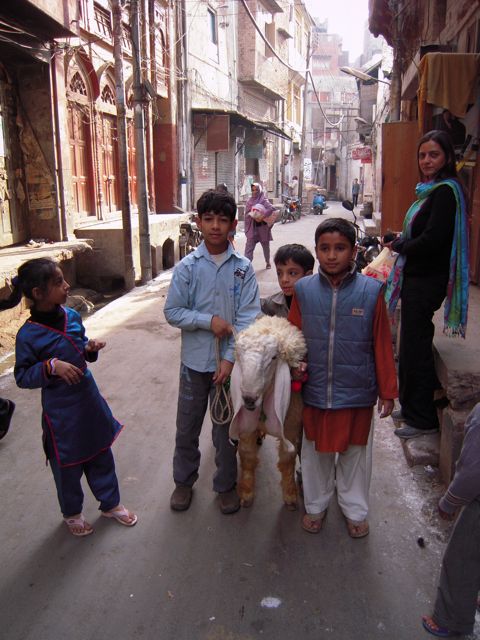 Beautiful animals for Eid
 Remains
 Skins on a bike
 Skins at the roadside


